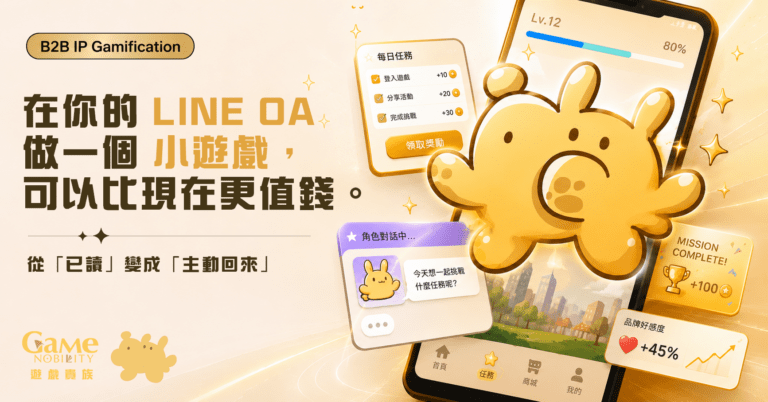
Now that marketing mini games are cheap, what should brands really pay for?
GameNobility | Are mini games really cheaper in the age of AI?
Now that marketing mini games are cheap, what should brands really pay for?
Before 2023, a brand that wanted a mini game in its campaign usually had to hire a development team to build it from scratch.
Today, third-party LINE tools offer ready-made game templates, AI can generate characters and visuals in minutes, and it can even write code that works. The cost of making "a mini game" is falling fast.
That's a good thing. But it also makes one question clearer: when every brand can make a mini game, what will make yours the one people remember?
The bottom line: tools have made "getting it built" cheap, but "getting it right" hasn't gotten any cheaper. What brands should really pay for is judgment, translation, integration and accountability for results.
Key points in 30 seconds
- Templates and AI have made "building a mini game" cheap, but "getting it right" hasn't gotten any cheaper.
- For a one-off prize draw with no need for brand differentiation, a template is enough. Custom work is worth it only when you need to judge gameplay, translate IP, integrate systems or be accountable for results.
- When choosing a partner, instead of asking "Can you build this?", ask "What would you advise me not to do?"
First, when a template is enough
We don't think every need should be custom-built.
If all you need is a one-off spin-the-wheel draw, your budget is limited and you don't need to stand out from other brands, a ready-made template is a sensible choice. Spending the money on prizes and ad placement may work better.
Custom work is needed in four other situations.
1. Deciding what to build: translating goals into gameplay
At the start of most projects, the client has just one goal in mind: acquiring new users, re-engaging members, helping employees remember guidelines or getting a character known by more people.
Many decisions lie between the goal and the gameplay. Dcard initially discussed mahjong and card games, but the team ultimately chose hyper-casual gameplay because card games can make people associate the brand with gambling. A template won't make that call for you, and AI will only give you the most common answer.
"Tools answer 'how to do it'; experience answers 'whether to do it this way.'"
2. Letting IP be experienced, not just pasted on
Drop a brand character into an off-the-shelf match game, and the character is just a sticker.
Real IP adaptation means letting the gameplay itself express the character's personality and world. In Sort & Chill, which we co-developed for Meta Horizon Worlds, we extended match-3 gameplay into world shops, a collection book, a personal display case and a rarity system, so players aren't just matching but collecting and showing off a journey. When gameplay and world are tied together, players remember not just the game, but the IP.
Further reading: Sort & Chill | A replayable match-and-collect game by GameNobility
3. Integrating with existing platforms and systems
The bigger the company, the less likely a game can stand on its own.
It has to live inside an app, connect to membership, hook into leaderboards and sharing, and follow existing engineering specs and testing processes. Dcard's game is embedded directly in its app, involving APIs, data exchange and Android and iOS compatibility. This work is invisible, yet it decides whether a project can launch.
Being able to fit into a large platform's working rhythm and translate technical language into specs every department understands is the part templates and AI tools find hardest to replace today.
4. Being accountable for results: pacing, balance and testing
Whether a marketing game keeps people around often comes down to details: whether the first level is too hard, whether scores grow at a pace that makes people want another try, and whether the end screen gives players a reason to share.
These come from balance design and real playtesting. AI can crunch numbers, but it struggles to sense the exact second a player starts getting impatient.
What this means for brands
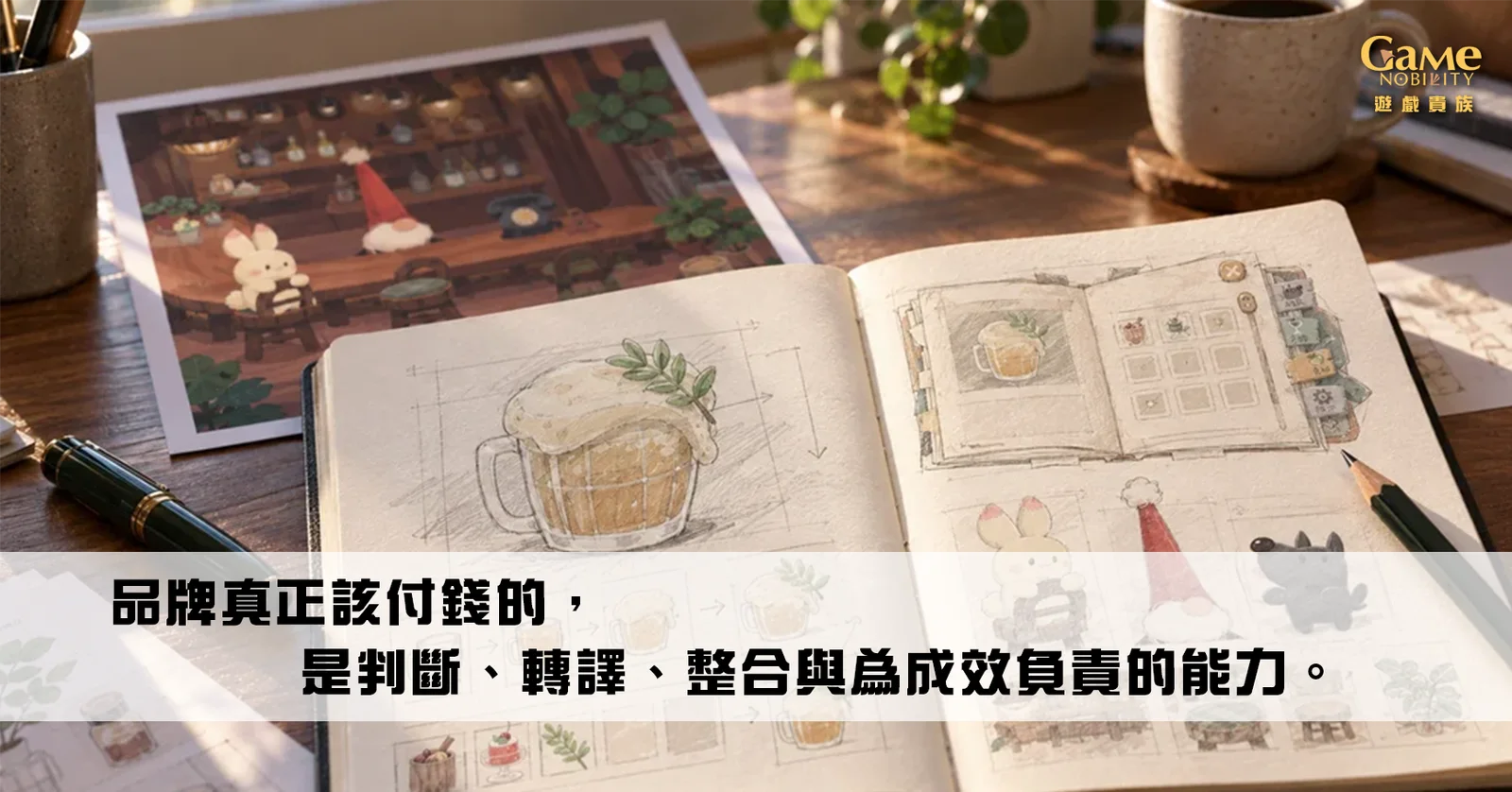
Budgets should be reallocated: spend less on "getting something built" and more on "figuring out what to build" and "making it run reliably in your systems."
When choosing a partner, try asking a different question: not "Can you build this?" but "What would you advise me not to do?" Only a team that can answer the latter is really thinking about your project.
Three questions to ask yourself before evaluating
- What would be lost by using a ready-made template for this need?
- Does my character or brand have a personality worth bringing to life through play?
- Which existing systems does the game need to connect to, and who is responsible for integration?
FAQ
Q1: Will AI replace game development companies?
AI will replace some repetitive production work, and we use it in our own workflow. But judging gameplay, translating IP, integrating systems and being accountable for results still require experience and cross-team communication.
Q2: How do LINE game templates differ from custom games?
Templates suit simple, one-off campaigns. Custom games suit projects that need brand differentiation, IP expression or integration with your own systems.
Q3: What kinds of brands are a good fit for IP gamification?
Brands that already have characters, stories or a world, and want their audience to remember it for the long term. What matters is not the size of the IP, but whether it has a personality that can be experienced.
Q4: How do large platform partnerships differ from typical brand projects?
More roles are involved, technical specs are stricter and testing takes longer. The development team has to keep pace with the partner, not just deliver a finished product.
Q5: Will GameNobility advise clients against going custom?
Yes. If a template can achieve the goal, we'll say so directly. Putting the budget where it's really needed is the foundation of a long-term partnership.