How to read a custom game quote: 5 factors to understand before you ask and compare
GameNobility | Game marketing budgets
How to budget for a marketing game: 5 factors behind a custom game quote
"Roughly how much does a mini game cost?" This is the question we hear most often in a first meeting.
We never answer with a single number. The same "mini game" could be a spin-the-wheel draw built in a week, or a three-month pet-raising game connected to a membership system. The price gap can be more than tenfold, and the difference never lies in how big the visuals look.
In one sentence: the price of a marketing game is set by five things: gameplay rules, art volume, system integration, launch environment and review rounds. Think these five through first, and the quotes will naturally converge.
Key points in 30 seconds
- The price of a marketing game does not depend on 2D or 3D. It is set by five things: gameplay rules, art volume, system integration, launch environment and review rounds.
- The most underestimated parts are the invisible ones: leaderboards, membership, prize redemption, app integration, and multi-department reviews at large companies. On a tight budget, cut scope, not the core experience.
- Before asking for a quote, be clear on what players should do after playing, where the game will live and who has the final say.
Factor 1: how many rules the gameplay has, not 2D vs 3D
Many clients first ask how much 3D costs compared with 2D. But what really drives working hours is how many rules in the gameplay must be designed, built and tested.
A tap-to-win draw has just one rule: tap and get a result. A merge game has to handle falling objects, collisions, merge conditions, scoring and end conditions. A raising game adds time, state changes and return-visit mechanics on top. Every extra rule means another round of planning, programming and testing.
“Visuals win the first glance; rules decide the hours.”
Factor 2: art volume, and whether assets already exist
Art costs depend on how many things need to be drawn: the number of characters, animations per character, scenes, props and UI screens.
If the brand already has a character IP, it may look like you save on design fees, but you need to set aside time for something else: review by the IP owner. Character expressions, proportions and colors may all need back-and-forth checks, especially when a licensor is involved. On the Dcard project, we planned characters, props and interface together, which avoided repeated revisions late in the project.
Further reading: "Why did Dcard choose GameNobility?"
Factor 3: whether to integrate, and with whose system
A front-end-only game that ends when play ends is the simplest. Add any one of the following and you need a back end and data handling: leaderboards, member login, lucky draws and prize redemption, return traffic from shares, or integration with an existing app or API.
This part is the most underestimated because it is invisible on screen. Dcard's game had to sit directly inside its app, which involved APIs, leaderboards, sharing, and Android and iOS compatibility. Engineers from both sides sat down together to agree on responsibilities, and that is what got the project to launch.
Factor 4: where the game will be played
A LINE Official Account, an in-app web view, a brand website, a large screen at an exhibition, or many players connecting at once at a year-end party: each environment has different technical conditions.
The more launch environments, the more compatibility testing. Phone models, network conditions and browser versions all have to be tested on real devices. This is why we insist on keeping human QA: automated tests can confirm whether features are broken, but they cannot feel whether the pacing drags or whether the instructions make sense.
Factor 5: how many rounds of review and communication
This item never appears in a spec, yet it is the most real cost in large corporate projects.
The more people involved in decisions, the more contacts need to sign off at each stage: brand, marketing, legal, IT and senior management. Each extra review gate means more buffer in the schedule. Writing down "who approves what, how many days to reply and what the acceptance criteria are" before kickoff often controls the budget better than any technical choice.
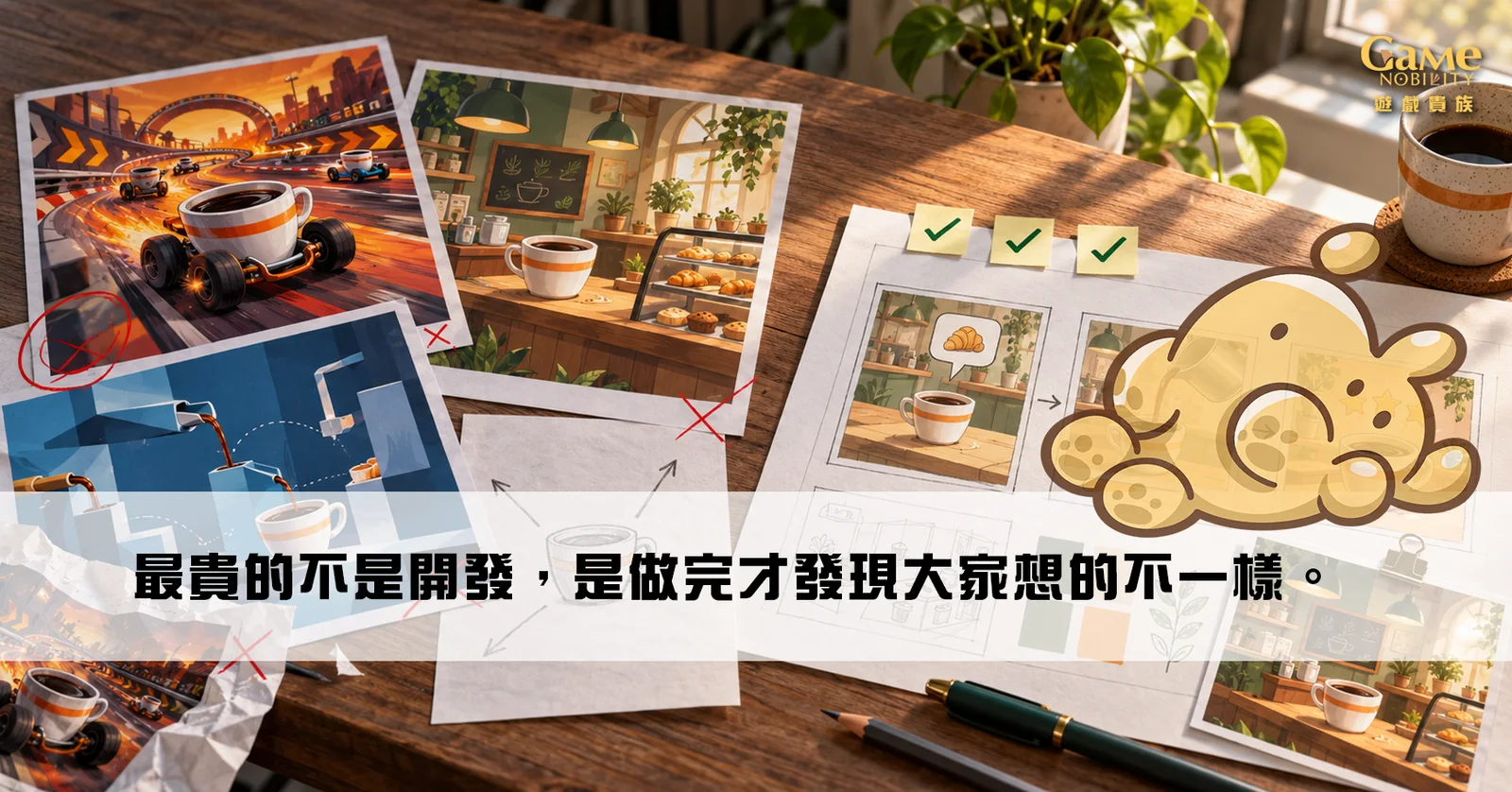
“The most expensive part is not development; it is finding out after it is built that everyone had something different in mind.”
What projects of different sizes roughly look like
| Scale | Typical format | Common integrations | Full timeline | Reference budget |
| Light interaction | Lucky draws, personality quizzes, single-level mini games | None or a simple form | 1–3 months | From NT$150,000 |
| Standard marketing game | Merge, match-3 or quiz games with leaderboards | Leaderboards, sharing, lucky draws | 2–6 months | From NT$300,000 |
| Integrated project | In-app embedding, IP adaptation, multiplayer | Membership, APIs, admin back end | 6+ months | From NT$1,000,000 |
On a tight budget, what do you cut first?

Cut scope, not the core experience.
Levels can go from ten to three, and characters from five to two. But the feel of the player's first minute, clear instructions and an end screen that leads to sharing cannot be cut. A small game done completely usually works better than a big game with many features that is rough everywhere.
Three questions to ask yourself before requesting a quote
- What do I want players to do after they play? (Add us as a friend, leave their details, share, visit a store)
- Where will this game live, and which existing systems does it need to connect to?
- How many people inside the company need to approve it, and who has the final say?
If you can answer these three, the quotes you receive will be more accurate and easier to compare across vendors.
It is fine if you have not sorted this out yet. Step into the Guardian Dog's Dream Commission Office and sort out your project needs through a game, or fill in the request form directly.
FAQ
Q1: Can you give me a rough price first?
We can give a range, but only after we confirm the gameplay type, the launch environment and whether integration is needed. Without these three, any number could be off by several times.
Q2: Is a ready-made template or SaaS tool cheaper?
Yes. If you only need a one-off lucky draw and no brand differentiation, a template is a sensible choice. Custom work pays off when the gameplay, characters and experience need to be designed for your brand, or when you need to connect to your own systems.
Q3: Once the budget is set, can features be added later?
Yes, but we recommend planning the architecture for them at kickoff. If leaderboards or membership were not planned from the start, adding them later usually costs more than building them in from day one.
Q4: Does a quote usually include maintenance after launch?
It varies by vendor. Ask directly how long the warranty lasts, which fixes it covers and whether system updates are billed separately. This is the item most often overlooked when comparing quotes.
Q5: Why do two vendors' quotes differ so much?
Usually they understood the scope differently, or one of them left out integration, testing or review rounds. Ask vendors to list their work items and you will see where the difference lies.