Does turning employee training into a game really work? Research data, live quiz events and five pitfalls to avoid

GameNobility | Gamifying employee training
Yes, but not just because "games are fun". A meta-analysis of 40 experiments found that gamification has a positive effect on learning outcomes, motivation and behavior, provided it is designed well. This article covers the research data, design methods and technical rollout in one place.
Key points in 30 seconds
- Research supports a positive effect of gamification on cognitive learning: the Sailer and Homner (2020) meta-analysis found an effect size of g = 0.49.
- Designs that add a story setting and social interaction have a clearer effect on behavior change.
- The most common failures: only adding badges, leaderboards that become public shaming, no difficulty curve, slow feedback, and no measurement after launch.
What the data says: not magic, but a steady positive effect

A meta-analysis published in Educational Psychology Review covered 38 papers and 40 experiments. It found an effect size of g = 0.49 for gamification on cognitive learning outcomes (Sailer & Homner, 2020), 0.36 for motivation and 0.25 for behavior.
In plain terms: in education research, g = 0.49 is a "small to medium difference that is worth taking seriously". It won't turn anyone into an expert overnight, but it is enough to help people absorb the same material better.
The study also notes that the size of the effect depends heavily on the design. In particular, a game story setting and social interaction had a significant effect on behavior. In other words, printing the employee handbook on playing cards does not count as gamification.
Why it works: the forgetting curve, and the part of everyone that wants to win

In 1885, Ebbinghaus experimented on himself and drew the famous forgetting curve: content you don't review is soon forgotten. Education research has since confirmed again and again that active recall keeps memories better than simply rereading.
Quizzes, levels and scenario choices are all, at heart, ways to create chances for active recall. The difference is that players don't feel like they are reviewing. They just feel like they are going for the next question.
Self-determination theory explains why people get involved: autonomy (I chose this), competence (I can do this) and relatedness (I'm doing this with my team). A good training game takes care of all three.
How it works on site: from the Micron quiz to year-end party team levels
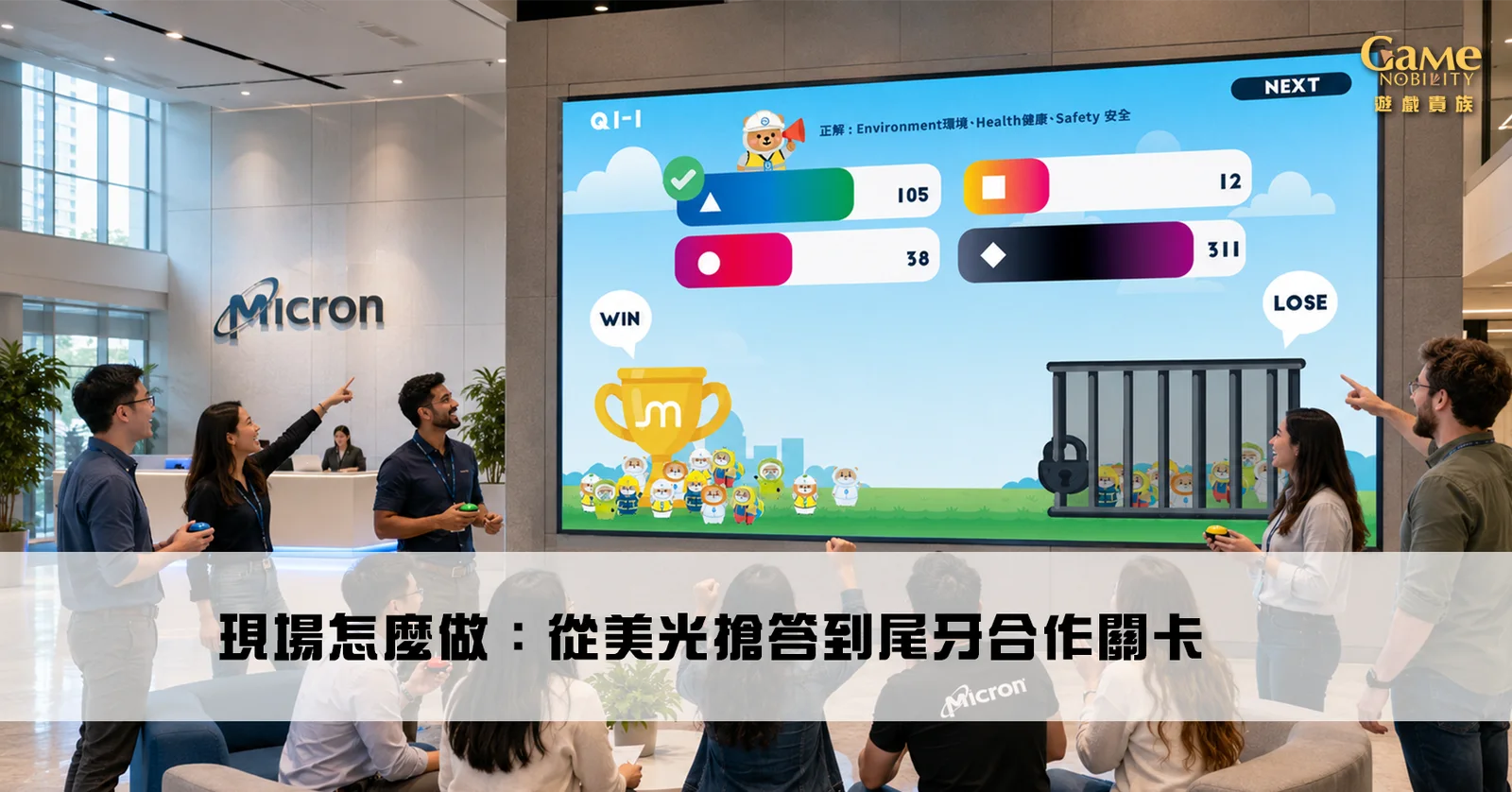
The quiz game we made for Micron Taiwan's staff day turned the employee code of conduct and information security knowledge into a question bank and a competitive quiz, adding corporate branding, a mascot, hidden achievements and themed-day activities. The serious content was not watered down. It was simply presented in a way people want to take part in.
Kingston's Rex Explorer, used at a year-end party, took a different route: multiplayer teamwork. When a challenge needs the whole team to complete it, the discussion itself becomes a way to connect, and even the quietest colleague can become a key teammate.
Further reading: "Why did Micron turn its employee code of conduct into a quiz game? A staff day training gamification case study"
Both projects share one principle: first decide what you want people to remember and do, then choose the gameplay.
"Gameplay is the means, not the star."
The five most common pitfalls
1. Only adding badges
Points, badges and leaderboards are not all there is to gamification. Without a meaningful challenge, a badge is just a digital sticker.
2. The leaderboard becomes a public shaming
With a company-wide individual ranking, the top ten are happy and everyone else quietly closes the app. Use team boards, personal progress boards or group matches instead.
3. No difficulty curve
Too hard and people give up. Too easy and they get bored. Let the first few questions build confidence, then make it harder step by step.
4. Feedback comes too late
After each question, people should ideally learn right away why they were right or wrong. A score report a week later gives the weakest learning results.
5. No measurement after launch
Without a pre-test, post-test or completion rate, you can't prove it works or know what to change in the next version.
Three technical questions to ask first
Where will people play?
On phones, on a big screen in a meeting room, or on the company's internal learning platform? Different entry points mean different interface and performance needs.
Does it need real-time multiplayer?
Live quizzes and team battles need server sync and a plan for connection stability. Solo challenges are much simpler.
Where will score data be stored?
Whether personal data is involved, and whether it needs to connect to HR or learning systems, is best confirmed before the project starts, so security and permissions aren't patched in at the end.
How do you prove it really works? The three most practical measures are the difference between pre- and post-training tests, performance on scenario tasks, and the completion rate. If you can, also compare it once with your previous training method.
Remember to set the observation period first. Excitement in the first week after launch is not the same as a lasting effect. Recall after 30 and 90 days is much closer to the real learning result.
Want to apply this approach to your project?
Share your goals, audience and planned launch date, and we'll put together a recommended plan and estimate based on scope.
- Fill in the commission form: https://www.gamenobility.com/commission-request-contact-form/
- See training gamification case studies and how we quote: https://www.gamenobility.com/#need-learning
FAQ
Q1: Does it suit older employees or people who rarely play games?
Yes, as long as the controls are intuitive and the rules fit in one sentence. Run a small trial first, see where different age groups get stuck, then adjust the interface and difficulty.
Q2: Does it have to be a full game?
Not necessarily. A single-topic interactive quiz, scenario choices or a team quiz may be a better place to start. Confirm the training goal first, then decide on the format.
Q3: Can it go into our existing learning platform?
It depends on the formats and integrations your platform supports. Web-based interactive content is usually easier to embed or link. If scores need to be sent back, check the platform's integration specs first.
Q4: Is gamified training guaranteed to improve performance?
No. Research shows gamification has a positive effect, but real results depend on the content, the design and how it is rolled out. We recommend checking with pre- and post-tests and on-the-job task performance.